

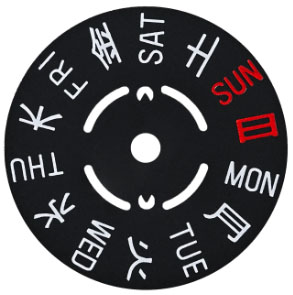
If you own a Seiko watch made in Japan with a day-date window, you’ve probably noticed those small, elegant kanji characters rotating through. They look nice enough. Clean, compact, vaguely meaningful. But what are they actually saying?
Simple answer: they’re Japanese abbreviations for the days of the week. Nothing complicated.
The Elements
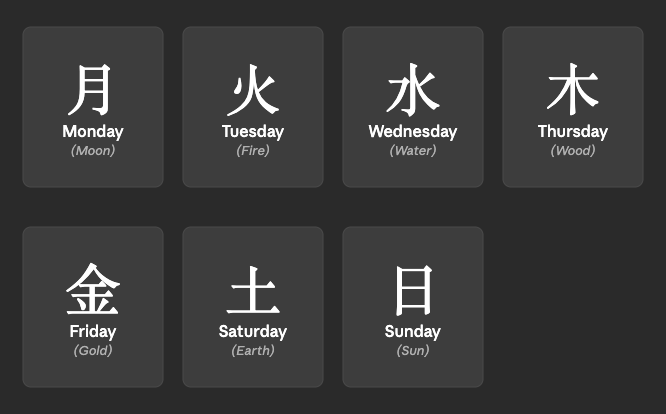
The naming system comes from traditional East Asian cosmology. Each day gets paired with a celestial body or natural element:
- 月 (getsu) moon → Monday
- 火 (ka) fire → Tuesday
- 水 (sui) water → Wednesday
- 木 (moku) wood → Thursday
- 金 (kin) gold/metal → Friday
- 土 (do) earth → Saturday
- 日 (nichi) sun → Sunday
The Japanese borrowed this system from China centuries ago, and it stuck around. You’ll see the same kanji on calendars, scheduling apps, and anywhere else that needs a compact weekday label in Japan or East Asia.
Why It Matters
It’s a detail grounded in actual history rather than arbitrary design. You’re looking at a system that’s been around for over a thousand years. Clean presentation, useful information.
Next time someone asks, you’ll know what to tell them.